Among traditional athletes, the prime usually arrives in the late 20s to early 30s. In esports, it has historically come much earlier. Is that true, and if so, why? This analysis attempts to answer both questions.
To set a baseline, I limited the data to the modern era of Siege, from 2020 onward. Most players would agree this is when the game’s skill level truly accelerated, especially after the pandemic.
Inside look at Rainbow Six Siege pros
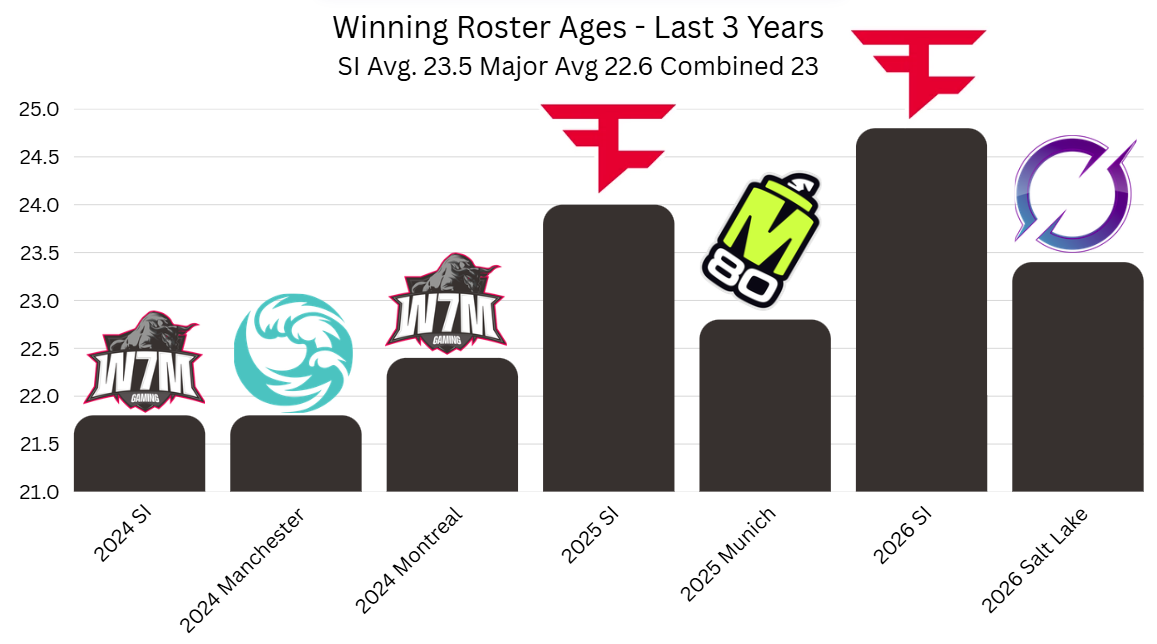
Across every major from 2020 through Salt Lake City, the average age of a championship player was 22. That figure comes from the winning rosters of 11 majors, 55 players in total. BDS was the oldest champion, averaging 24 at Jönköping. DarkZero’s two title-winning squads, in Charlotte and Salt Lake City, were next at 23 each. The youngest champion was Team oNe at the 2021 Mexico major, whose historic run came at an average age of just 20.
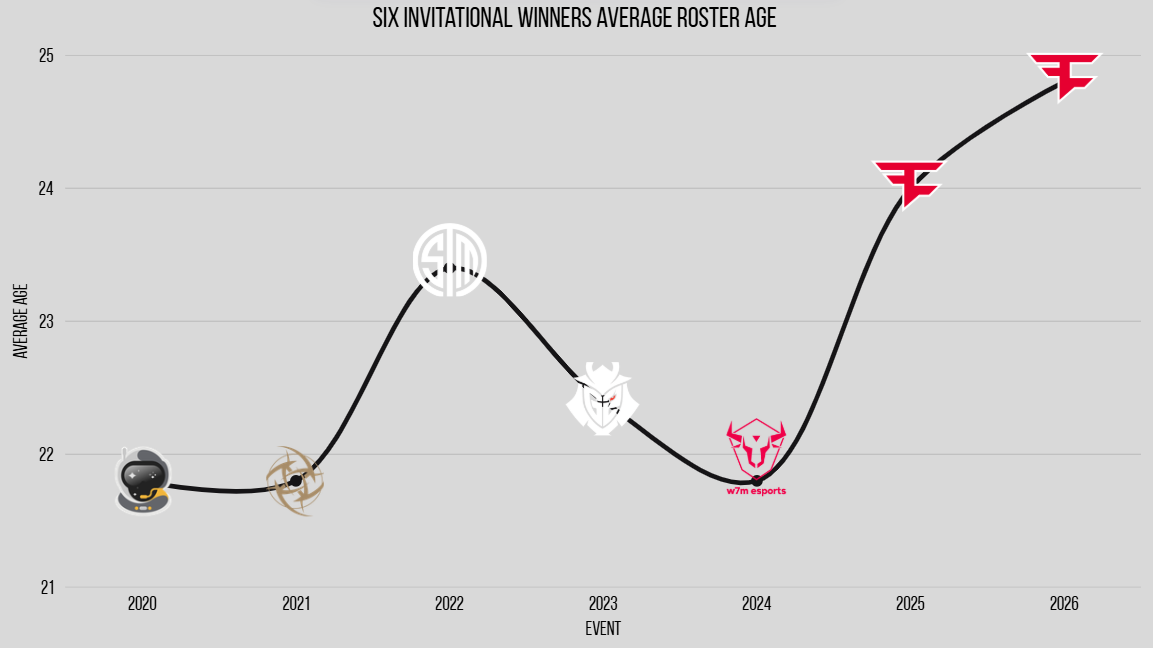
Looking at the winners of the Six Invitational, across seven championships, the average age again sits at 22. Unsurprisingly, the oldest roster to win is FaZe Clan, which took the title twice, averaging 24 in 2025 and 25 in 2026.
Over the past three years, a clear trend has emerged: the average age of a team winning an S-Tier international tournament has risen to 23 and appears to be climbing. With DarkZero and FaZe consistently at the top of the field, Siege seems to be entering an era in which experienced cores are best positioned to go the distance. Whether this shift proves lasting, or merely holds until a new wave of talent arrives, only time will tell.
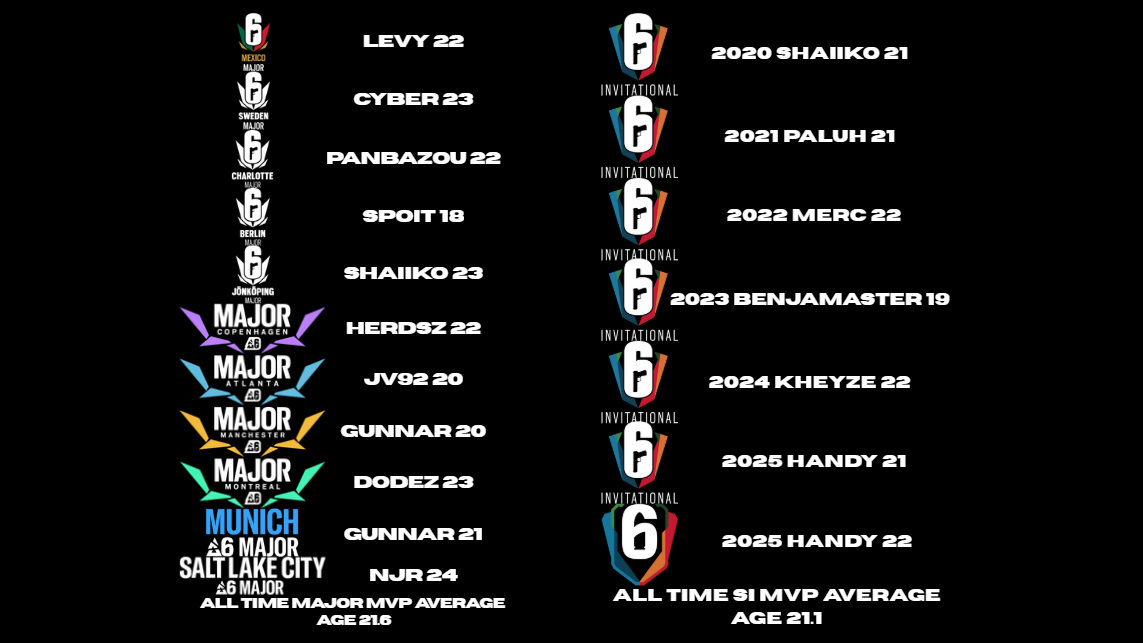
Siege is a team game, but the individual standouts matter too, so I also examined the MVP, or highest-rated player, of every S-Tier international event since the Six Invitational 2020. MVPs skew notably younger than the winning rosters, averaging just 21. The youngest, and the only MVP to win at 18, is Spoit, who earned the award at the 2022 Berlin Major. The oldest, in keeping with the trend, is the most recent MVP, NJR, who was 24 at the time. The gap is unsurprising: in Siege and many other esports, younger players are slotted into aggressive “frag” roles, which give them more opportunities to produce the numbers that earn MVP honors.
Going into the Osaka Major, I had one question: does the trend of top players getting older continue? Thankfully, North American caster Jesse "J Chick" Chick has helped answer it. He shared the average age of every team competing at the event, and one thing stood out to me: most teams sit right around 24 years old. Averaging all 20 teams gives roughly 24.2 years.
We don't know the winner yet, but it's likely the winning roster will land close to that mark. The youngest teams in the field are Tyloo (22.02), Cloud9 (22.45), and M80 (22.57), so one of them could upset the narrative that older players will keep winning
Prior Research
While looking directly into Rainbow Six events thus far has gotten us a lot closer to answering the question, let's take a look at some other research and data that will help support this idea we’ve been building.
In 2026, Jimoon Kang analyzed more than 250,000 tournament records covering 50,441 players across 201 games from 1997 to 2023, asking at what age esports professionals reach peak career earnings. In most titles, earnings peaked around age 21. Kang also found that esports careers are far shorter than those in traditional sports, and he identified the absence of player support systems as a central problem. The industry is still young: player unions that secure funding and protections have not developed at scale, and income, whether from competition or content creation, is inconsistent and varies widely. Without financial and institutional support, most players struggle to sustain long careers.
In 2014, researchers at Simon Fraser University used replay data from more than 3,000 StarCraft 2 players aged 16 to 44 to measure reaction times and pinpoint when self-initiated responses begin to slow. Reaction and input speed began declining around age 24 at every skill level, and expertise did not offset it. Older players compensated with mechanics that reduce cognitive load, much as aging players in Rainbow Six Siege and other FPS titles often shift into more supportive roles. Over a 15-minute game, a 39-year-old loses roughly 30 seconds to cognitive lag compared with a 24-year-old.
Together, the studies place peak skill and opportunity between roughly 21 and 24, though culture, experience, and game title warrant further study.
What the Pros Say
Statistics only go so far, so I polled ten active T1 players on when they believe a player’s career peaks. Seven chose 24-26, two chose 21-23, and one chose 18-20. The majority therefore sits notably older than the data suggests. This is unsurprising given the recent trend among top Rainbow Six organizations toward proven, experienced rosters. DarkZero, Falcons, FaZe, and M80 are among the largest organizations and field some of the most seasoned lineups. For well-funded organizations, veteran talent is the safest route to contending in regional leagues and at international events like the majors and the Six Invitational.
Smaller NAL organizations such as FiveFears and ForFun carry less risk and can afford to gamble on unproven talent. Cloud9 is the best example: a roster with three rookies that defied expectations and qualified for the Osaka Major over much larger organizations. It is a compelling story, but it remains the exception among qualified teams.
In a recent feature, I spoke with star player Iconic about his career in competitive Siege and his comeback from a major injury, and he described the underrecognized physical toll esports takes on the body.
When you're gaming a lot, your forearm overcompensates if your back muscles aren't working as hard, and that was happening to me. So I reintroduced workouts like rock climbing, swimming, and lifting to rebuild strength and grip. It was an extremely fun process in the end.
Traditional sports have decades of medical research covering nearly every discipline. Esports has almost none of the physical damage players endure over a career. Even if the demands of esports fall short of those in traditional sports, this remains a side of the industry that has gone largely overlooked. Without consistent documentation and peer-reviewed research, there is no way to know how many players have suffered physical conditions, or how many went untreated because they lacked proper information. Carpal tunnel syndrome, spinal sprains, and disc issues can become chronic, shortening or ending careers and affecting players for the rest of their lives. Until proper research exists, we can’t truly measure how much these injuries shape the career span of esports players.
Conclusion
I examined three areas: direct data from professional Siege careers (including MVP ages, international teams, and player ages), two studies from outside Siege, and player opinions and sentiment. These findings led to two conclusions. First, a player’s prime appears to begin around 21, peak near 24, and decline after 26. Second, the idea of a “prime” or “peak” age is highly subjective. Both the objective data and players’ own experiences show that the range varies. Mechanically, players peak between 21 and 24, but that doesn’t necessarily make it their winning peak, since most aren’t positioned to win an event until the latter half of that window.
I’ll end with one question: when judging the perceived value of a Rainbow Six professional player, which matters more, raw mechanical skill, or the experience and maturity to lead themselves and their team into a position to win?